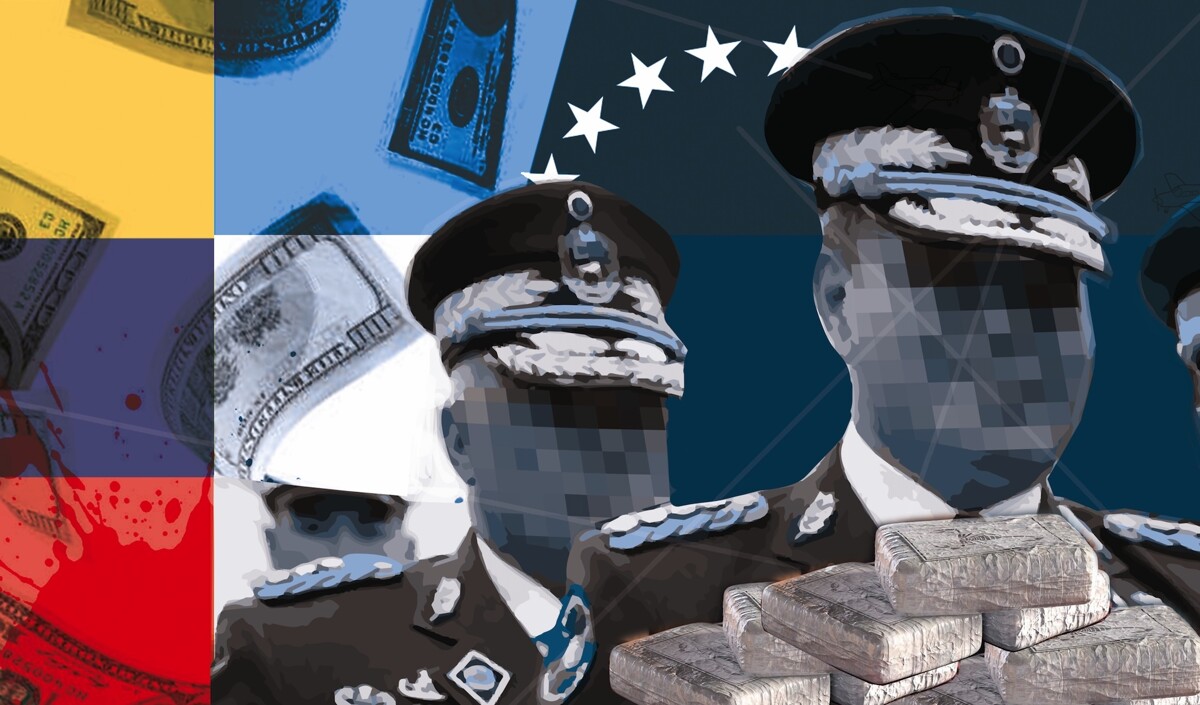
A major transnational journalistic investigation, led by the Organized Crime and Corruption Reporting Project (OCCRP) in alliance with the Latin American Center for Investigative Journalism (CLIP) and associated media, has reignited analysis over the alleged involvement of the Nicolás Maduro regime and high-ranking Venezuelan military officials in international drug trafficking. The investigation, first published on November 6, 2023, is based on a massive leak of documents from Colombia's Attorney General's Office and includes dozens of testimonies and judicial cases from the United States and Europe. The dossier mentions over 75 names of high-ranking officials—military, businesspeople, and regional authorities—who were cited in the leaks and judicial documents. According to the report, a criminal network linking the Venezuelan Army and National Guard has generated a transportation infrastructure ranging from rivers and farms to clandestine airstrips, allowing the 'Cartel of the Suns' to move from mere transit to its own processing of cocaine in Venezuelan territory. International relations experts emphasize that 'the management of cocaine trafficking in Venezuela is not something new,' and attribute a main role to the Maduro regime in the money laundering and distribution mechanism. The OCCRP publication highlights that some economists and jurists point out that the regime's continuity also depends on this 'institutionalized narco-state.' One of the key implications of the document is that the 'Cartel of the Suns' not only operates in drug trafficking but has diversified into sectors such as illegal mining, logging, gasoline smuggling, arms trafficking, and prison exploitation. The leaks have also generated requests for investigation at the International Criminal Court (ICC) for 'money laundering, international trafficking, and human rights violations.' The data in the investigation raise critical questions about Venezuela's evolution: to what extent does the State allow or facilitate organized crime operations, and how does this collusion affect regional stability. On August 28, 2025, the U.S. government designated the 'Cartel of the Suns' as a terrorist organization, opening the door to more intense legal actions. The investigation details that the criminal structure formed alliances with the Sinaloa Cartel and the National Liberation Army (ELN), operating under a 'diffuse but real' military command that moves up to 350 tons of cocaine a year on international routes to the U.S. The U.S. accused Maduro and high-ranking officials in 2020 of leading the 'Cartel of the Suns.' For neighboring countries and international partners, the possibility of effectively combating this network requires cross-border cooperation, financial controls, and sanctions that go beyond the symbolic. In Venezuela, the investigation could have internal effects: a weakening of the power structure that supports the regime or a hardening of its repressive apparatus. Following the Colombian leak, journalistic reports added precise coordinates on the group's internal functioning and its military leadership. In August 2024, when Diosdado Cabello was named Minister of the Interior, it was interpreted as a powerful political signal: a presumed cartel leader occupying a key security portfolio. Experts highlight four central objectives of the network: funding military units, enabling safe drug exit corridors, using military infrastructure for transport, and controlling strategic ports and airports. This expansion coincides, according to analysts, with geopolitical backing from countries like China and Russia, which would reinforce the sense of impunity of the Venezuelan structure. The investigation is published as the international community has increased sanctions and diplomatic pressure on Caracas. With this architecture, the organization ceased to depend on third parties to process or export narcotics.