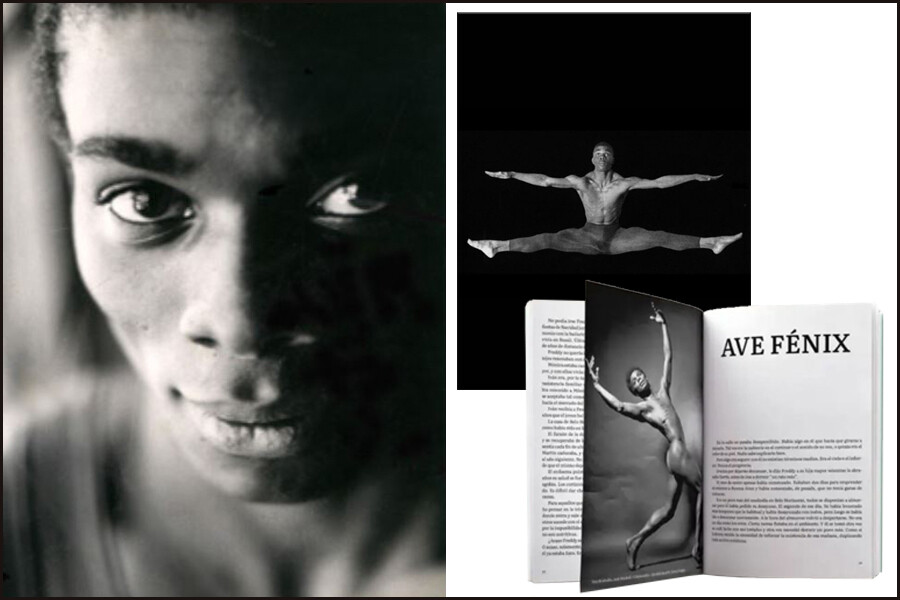
The book, based on meticulous archival work and including interviews with relatives, friends, students, and colleagues, features dozens of stunning photographs showcasing the dancer's skill and adventures.
"Black Bird That Dances" is a biography of Freddy Romero by Dulcinea Segura Rattagan, shedding light on the forced odyssey of any movement artist born in a Latin American country. Romero was born in Venezuela into a very humble family. From a young age, he realized that movement was his true homeland.
As a teenager, he secured a scholarship to continue his training in the United States, where he studied at the Martha Graham school. It was this technique that Freddy Romero would champion and spread throughout his life. He later moved to Argentina for the woman he loved, where he received the highest recognition: a solo piece composed by Alvin Ailey himself.
While focusing on Romero's life, the book also points to the widespread issue of neglect by public and private institutions towards artists. The body leaves its shell, but nothing ceases. Death is a date; movement dissolves its stone sculpture.
This biography is more than just a collection of anecdotes. The narrative, rich with beautiful photographs, is a quick read, creating a virtuous tension between emotion and information. The book uses the metaphor of the dancer-as-bird to title each section: "Phoenix," "Freddy Bird," "The Nest," "Taking Flight," to name a few.
Freddy Romero lived a life torn between love for his fellow human beings and love for dance. In his classes, he infused a connection with his Afro-Latin American roots, and the Graham technique in his teaching carried a powerful sexual and vital energy. What impressed me most about his classes was the atmosphere that enveloped them, a blend of ritual and celebration.
The book illuminates the forced odyssey of any movement artist born in a Latin American country. In an era when dance was associated with a hegemonic notion of beauty, this idea fascinated me. Freddy Romero began his career at a time when Classical and Contemporary dance were on separate tracks, belonging to disciplines that were not meant to touch. Bodies, even those of artists who reached the pinnacle of their expressive talent, were treated with disdain, pettiness, and severity.
The most important thing Freddy left me with, the axis of my entire work, was his saying that the Graham contraction was like vomiting; that phrase marked me. I quote it in my work. In fact, the fall of the heart, a step from Martha Graham—which, by the way, she spent ten years trying to understand—is present in my piece "Kill Me" (2024).