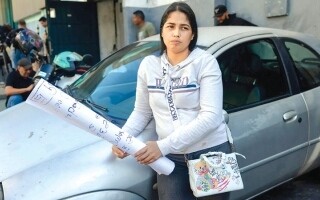
Forced disappearance is always used as a tool, and that tool aims not only to break the detainee but also to crush his family and torture them psychologically as well, said Martina Rappido, a researcher at Human Rights Watch. Rappido noted that these practices are sometimes carried out out of revenge against political opponents. Rappido explained that cases of forced disappearance usually take one of two patterns: the first is short-term arrests lasting for a few days, while the second pattern involves detaining prominent activists for long periods in secret places, with complete isolation from the outside world. In this context, 58-year-old Marilys Rodríguez traveled about 200 kilometers from the city of Acarigua to the capital Caracas in search of her son Carlos José Rodríguez (29 years old). Since that day, the authorities have not officially recognized his arrest, and the family has not received any information about his fate or place of detention. Since arriving in Caracas two weeks ago, Rodríguez sleeps every night outside the 'Zona 7' prison, although she does not know if her husband is actually being held in this prison at all. Despite the recent release of dozens of disappeared persons in Nicaragua, the fate of nine people remains unknown, according to prisoner monitoring organizations. Psychological suffering for families Marilys Rodríguez traveled to Caracas in search of her 29-year-old son. The Venezuelan government has not issued any response to inquiries regarding these cases. Forced disappearance Forced disappearance is an old practice dating back decades, used by dictatorial regimes in Latin America as a tool to suppress opponents, whether they were students, activists, or even foreigners. Liamaris confirmed that her father was not a political activist, but she pointed out that he recently had a dispute with neighbors who work as police officers, which led the family to wonder if this conflict was the reason for his arrest. Liamaris said: 'I am here only to make sure that my father is still alive, I want to know where he is now, and why he was arrested, and I demand from them to provide proof of that.' This method is classified as a gross violation of international law and a crime against humanity, due to the authorities' failure to disclose the whereabouts of any person detained in their custody, as some people in Venezuela have been missing for almost a year. Venezuelan law requires detainees to be brought before the judiciary within 48 hours of their arrest, but human rights activists confirm that this text is often neglected, especially in cases of forced disappearance, where families do not even know the place where their children are being held. The Venezuelan government launched a widespread repression campaign following the presidential elections held in July 2024, aimed at silencing the opposition, after Maduro announced his victory despite the vote counting results indicating the opposite. Rodríguez stated that her son was arrested only for investigation purposes, pointing out that they told her that they wanted to question him about something, but he has not returned since, and the family has not received any information about him for nearly four months. She confirmed that her son worked in selling imported goods and was not involved in any political activity. She added that Carlos became a father for the first time after his arrest, as his son was born without him being able to see him until now. The family mentioned that they searched for Carlos in at least five prisons in Caracas, and asked about him in all police stations in Acarigua, to no avail. Dispute with police officers Liamari is searching for her father in a notorious prison. Oriana says that her son has been missing since last August, expressing her conviction that 'Trump is the one who will get them out.' According to the non-governmental human rights organization For Penal, which is one of the main bodies concerned with documenting politically motivated arrests, the whereabouts of at least 66 prisoners in Venezuela are still unknown. However, they found no other option but to wait and hope. Political developments These sufferings come against the backdrop of remarkable political developments, where after the administration of US President Donald Trump arrested Venezuelan President Nicolás Maduro, the country's interim government has gained wide media coverage due to its announcement of the release of dozens of political prisoners. Human rights organizations confirm that these people were arrested arbitrarily, and the limited release operations have once again shed light on an old and recurring phenomenon in Venezuela, which is the disappearance of people after their arrest, often for political reasons. Trump's statements, in which he praised what he described as the tolerance of Acting President Delcy Rodríguez, have raised wide hopes among the families of the missing, in the hope that the rapprochement between Washington and Caracas will lead to revealing the fate of dozens of disappeared persons and their release. Karizos says with anguish: 'We are all here outside the prisons because of what Trump did.. Now all I want is the return of my husband.' Unknown places Karizos was not alone in this harsh waiting; mothers and wives who came from different parts of Venezuela spread their belongings on the streets surrounding the 'Zona 7' prison and set up their tents near dozens of police officers equipped with riot control equipment. Despite the police confirming that the prison is empty of detainees, the families say they hear screaming sounds coming from inside. Among them is Betsy Oriana, who is searching for her son Rudolfo José Rodríguez Oriana, a former police officer sentenced to 24 years in prison for participating in a plot to overthrow the government. From the source Liamari Brado traveled for eight hours by bus from the state of Guárico to the 'El Helicoide' prison in Caracas, known for its notorious reputation as a center for detention and torture, in search of her father Leonardo Brado, who has been missing since December 28 of last year. Trump's praise for what he described as the tolerance of the acting president revived hopes among the families of the missing.. 'International Amnesty' confirmed an increase in cases of forced disappearance in Venezuela after the 2024 elections. 'The Disappeared' The use of the term 'The Disappeared' dates back to the seventies of the last century in Argentina, when the military dictatorship at that time kidnapped nearly 30 thousand people, many of whom were tortured, and some were thrown from planes into the sea. For decades, this term was associated with the idea that the person is missing and probably dead, however, recent years have witnessed a change in the meaning, as it is now believed in countries like Nicaragua that the disappeared are still alive, but they are secretly detained without official records. After a strenuous journey that took about 10 hours by bus through Venezuelan roads, Carolina Karizos arrived in the capital Caracas; in search of her missing husband Omar Torres, 53 years old. His ex-wife, Ysbel Bello, 26, says: 'It's as if the earth swallowed him.' Eyewitnesses reported that vehicles with the insignia of the Bolivarian National Police arrived at the workplace of Borges, a prestigious private school where he worked as an animal supervisor in the petting zoo, and took him to an unknown destination. His family confirms that they visited countless government agencies, prisons, hospitals, police stations and even morgues, and each time the answer was the same: 'There is no person with that name.' Over time, Bello began to think that Borges might never return to her or her five children, and she says with tearful eyes: 'One day I will tell them about the great father they had.' From The New York Times. She said that her father was arrested at a checkpoint, as her family was informed. According to For Penal, about 800 people are still being held as political prisoners, despite the recent release of 154 people. Violations Human rights experts confirm that the disappearance of prisoners is the most dangerous form of violations, especially in countries that witness repeated violations, because detainees are completely outside the protection of the law, and families face great difficulty in appointing lawyers in cases that the authorities do not officially recognize, which increases the exposure of the disappeared to danger. Amnesty International pointed out in its report last year to a noticeable increase in cases of forced disappearance in Venezuela after the 2024 elections, confirming that some people disappear for hours or days or weeks, or even months. Clara del Campo, head of campaigns for South America at Amnesty International, said that families 'literally knock on prison doors' in search of their children, but the guards deny their presence, considering it a reflection of the 'ingenuity' of repressive systems in inventing new ways to practice cruelty and punish those whom they consider real or even imaginary opponents. Concern In turn, the family of the political activist Víctor Borges, 39 years old, continues to live in a state of anxiety since his disappearance on November 25 of last year. Upon her arrival, she did not find a shelter, so she made a primitive bed for herself from old sofa cushions, and slept in the open air in front of the detention center known as 'Zona 7'. Karizo recounts that 30 police elements stormed the family's home in western Venezuela about two months ago, during a search for weapons operation, and arrested her husband, a well-known political activist. She reported that the police arrested her son on September 23, 2025, on suspicion of illegally selling dollars on the black market. Among them are about 30 people who participated in the 'attempted invasion of Venezuela' in 2020, known as 'Operation Gideon,' which was a plan to kill Maduro or kidnap him and send him to the United States. That attempt, planned by a former American soldier from the special forces, failed miserably, as eight of the participants were killed, while the rest were arrested, and their fate has been unknown since they were transferred in August of last year.