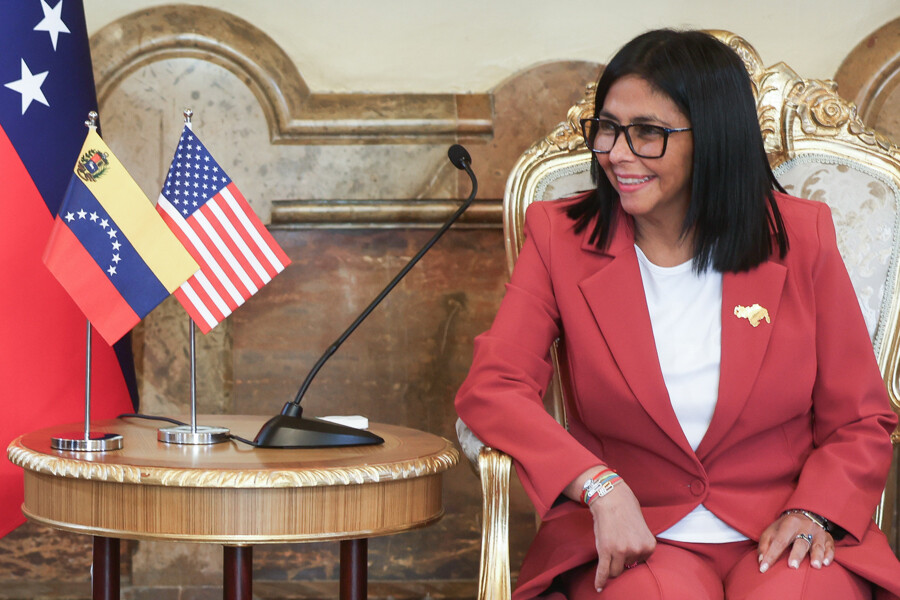
Delcy Rodríguez, the Chavist leader who took power after the detention of Nicolás Maduro, has been at the helm of Venezuela for a hundred days under the tutelage of the U.S., with an agenda focused on reforms to attract investment, while criticism over human rights and doubts about the legal framework of her management persist due to the lack of an electoral calendar. Rodríguez's rise has led, according to analysts consulted by EFE, to changes in strategic sectors like oil and mining, aimed at flexibilizing the legal framework and facilitating the arrival of foreign capital in an attempt to reactivate an economy battered by years of crisis. These reforms have been accompanied by announcements of fiscal and tax adjustments and the promise of a 'responsible' wage increase, in a context of worker protests demanding improvements in their incomes amid persistent inflation and a decline in purchasing power. In parallel, Rodríguez has pushed for a reconfiguration of the Executive, with changes in the cabinet and key areas of the State, in an attempt to adapt the government structure to a new political and economic scenario after Maduro's departure. Debate on elections One hundred days after taking office, one of the main points of tension remains the legal basis of her mandate and the absence of a date for elections. The Vente Venezuela party of opposition leader María Corina Machado has demanded that Parliament evaluate 'the absolute absence' of Maduro, which, she argues, would require calling elections 'within the next 30 days after said declaration'. In its ruling of January 3, the Supreme Court of Justice (TSJ) left the final legal qualification of that absence 'in the hands of other State organs', without setting deadlines for any eventual electoral process. In this context, former ambassador and professor Sadio Garavino warned EFE that for a 'long time' the Constitution 'has not been respected' in Venezuela, so he did not rule out that eventual changes may respond to 'political reasons' or 'external decisions'. Without committing to dates, the President of the Parliament, Jorge Rodríguez, stated last March that there will be elections, but he emphasized that 'the most important thing right now is the economy'. Human rights under scrutiny Another aspect that marks these first hundred days is the human rights situation, where organizations and experts warn of limited changes. For the lawyer and co-director of the NGO Acceso a la Justicia, Alí Daniels, although there is 'a certain openness in terms of freedom of expression', it is 'very limited', as there are still 'blockages to media portals', 'repression of the coverage of certain public acts' and journalists 'beaten at demonstrations', in addition to what he described as 'arbitrary' detentions. 'In these 100 days there has been a difference in degree, but not in nature of the regime: we have the same structures, especially in the repressive apparatus, practically intact, and what has happened is a restraint of repressive activity, but not its total cessation,' explained Daniels. Measures such as the approval of an amnesty law and the release of some detainees have been presented by the ruling party as advances towards reconciliation, although human rights organizations consider their scope to be limited and that they do not dismantle the existing control structures. In this sense, Daniels warned that despite these gestures, 'neither a change of regime nor the beginning of a transition can be spoken of,' by pointing out that there are still hundreds of political prisoners and that the releases represent only a part of the detainees prior to January 3.