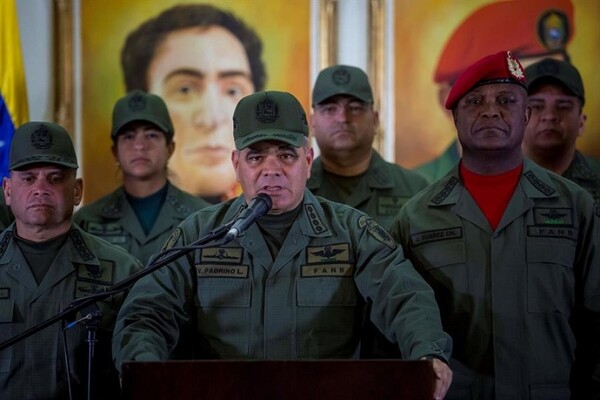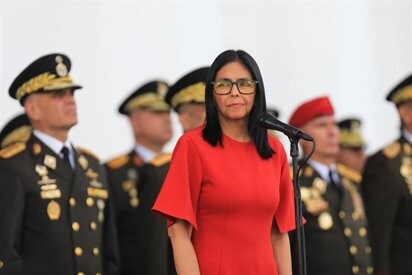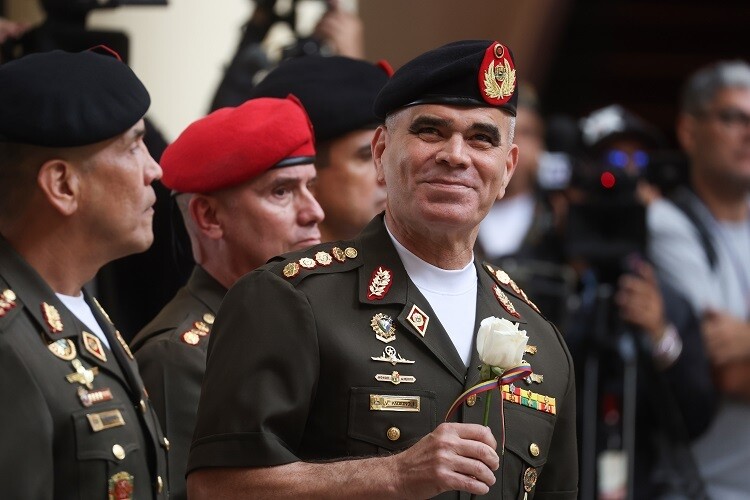
Historian and political analyst Pedro Benítez told EFE that Vladimir Padrino López was a pillar in sustaining Maduro and one of the reasons he remained in power for so long. In his message, Rodríguez referred to Padrino López as "the first soldier in the defense" of the country.
The dismissal of Padrino López was an almost inevitable consequence of the U.S. attack and, at the same time, a first achievement for Washington in limiting Russian influence in Venezuela, analysts pointed out. "Padrino's departure is cutting off the influence Russia had in Venezuela, which is allowing the United States to achieve one of its first objectives: incorporating the country into its sphere of influence," he stated.
Both analysts agree that the appointment of General Gustavo González López—a former Interior Minister and head of military intelligence and counterintelligence—likely had Washington's approval, although not necessarily explicitly.
However, González López is far from being a new face. "Maduro's capture in early January left Padrino López in a precarious situation, given the lack of an effective response from the FANB," explained EFE international law specialist Mariano de Alba.
To this are added the U.S. accusations against the now former minister, whom it has linked to drug trafficking activities since 2020. For Benítez, this removal is a symbolic closure of this first stage without Maduro and represents a signal of geopolitical realignment. Sanctioned by the U.S., the European Union, Canada, and Switzerland, his record raises doubts about his position and future actions.
A 2020 report from the UN mission investigating human rights violations in Venezuela stated there were "reasonable grounds to believe" that González López "was aware, participated in, and contributed to" "serious violations" of rights against opponents since 2014, when he headed the Bolivarian National Intelligence Service (SEBIN).
Despite these precedents, his appointment responds to Rodríguez's need to consolidate "his own circle of military support, putting people he considers loyal," Benítez noted, emphasizing that this is a normal process for any new head of state and adding that in the current circumstances there is "not much room for maneuver."
De Alba, for his part, believes that González López represents a figure of consensus within the ruling chavist leadership, particularly between the acting president, the head of the National Assembly Jorge Rodríguez, and the Interior Minister Diosdado Cabello. In his opinion, the appointment could facilitate, albeit to a limited extent, rapprochement with Washington.
"Most likely, they will bet on the FANB remaining cohesive and that with González López there may be opportunities to work on internal security and drug trafficking issues," he explained.
With this shift, chavism seeks to preserve its continuity amid a turbulent period, the analysts agreed. For Benítez, the changes implemented by Rodríguez are "reshuffles within the chavist nomenclature," a view shared by De Alba, who added that it is a continuity adapted to a new correlation of forces, but without signs of opening to a political transition.
Nevertheless, even with Trump's support—who has publicly praised the acting president—stability is not guaranteed, and it is a decisive factor for one of the central objectives both governments have expressed in this new stage: attracting international investment.
The replacement of General Vladimir Padrino López as part of a cabinet reshuffle in Venezuela cuts off the influence Russia had over the oil-producing nation and marks the closure of a first stage of stabilization for the government of Acting President Delcy Rodríguez to ensure the continuity of chavism in power, analysts told EFE.
Almost ten weeks after the U.S. military attack that led to the capture of Nicolás Maduro on January 3, Rodríguez ended, with a brief message on Telegram, the period of Padrino López's leadership of the Bolivarian National Armed Forces (FANB), an institution he led for over a decade and from which he consolidated himself as one of the most stable faces of the chavist leadership.
"Ultimately, it is a signal of possible political stability in the short term, but without substantially reducing the structural country risk for many investors," De Alba concluded.