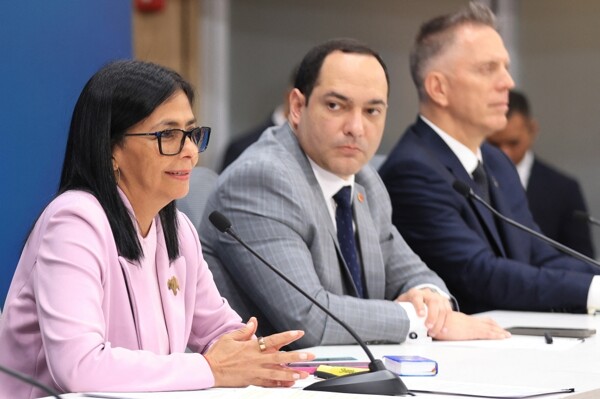
Imperialism operates by dissecting the body-territory of peoples to turn it into exploitable parts. Against this dismembering logic, decolonial sovereignty is exercised from and for the political body of the people, understood as a collective and indivisible unit. We see and experience it in our flesh in the repeated offensives and threats from the government of the United States against Our America, and in the attacks that are becoming more urgent, more grotesque, and more desperate every day, against the Bolivarian Republic of Venezuela. The historical colonial matrix of imperial domination, which articulates economic exploitation, racial hierarchy, and cognitive warfare, continues to function. Frantz Fanon warned us of the risk of an incomplete liberation in which national elites, converted into 'comprador bourgeoisie,' become internal agents of imperialism, reproducing alienation through think tanks and media, facilitating lawfare, cognitive extractivism, and the legitimization of sanctions against their own nations. Therefore, decolonial sovereignty is inherently cognitive sovereignty. It is the cement that gives coherence and historical depth to the unity of the body-territory, which in turn requires the fabric of new models of collective organization and protection, of mechanisms of community self-defense (physical, legal, cultural) against criminalization and imperial violence. It is, in essence, the capacity of a people/humanity to narrate itself, govern itself, and protect itself, breaking the visible and invisible chains of imperial coloniality. I would like to conclude by paraphrasing the words of Chávez, at this same event in 2004 that I mentioned at the beginning, which I believe perfectly summarize what I wanted to share with you: 'This is the offensive for humanity.' It implies a radical decolonization of subjectivities, a process of de-alienation in which peoples—far from being led—emerge as the subject that constructs its own forms of authentic self-representation. It is the ability to narrate the world with our own words, to resist imperial 'cognitive warfare,' and to create our own infrastructures of thought (community media, popular education, barter systems) that foster this liberating consciousness, breaking the imperial cognitive blockade. Because it is not just about defending a particular struggle, not just about articulating our struggles, but also about making each of our struggles one and the same struggle. In the face of the hydra of contemporary imperialism—which no longer operates only with tanks and ships, but also with sanctions, lawfare, and cognitive wars—the classic concept of sovereignty reveals itself as an illusion or a mystification that conceals new forms of dependence. How can we speak of sovereignty in a context of persistent coloniality? I believe the answer lies in decolonizing the concept itself, through a radical reconceptualization of the idea of sovereignty that arises as a response to that persistent coloniality of imperial power. I will present here, as a proposed scheme to articulate our reflections, the five dimensions that I consider important for thinking about this decolonial sovereignty, not as a static power of the State, but as an integral and collective praxis of self-determination. 1. It is a sovereignty, therefore, bodily and territorial. This idea of sovereignty as a collective body-territory transcends the metaphor: it is the materialization of a popular power that defends its physical and geographical integrity. 2. Sovereignty as Integral Historical Reparation. Imperialism not only plunders the present, but it steals the past and kidnaps the future through illegitimate debts and false, distorted historical narratives. It is important here to then pose the temporal and reparative dimension of a sovereignty that includes the right to claim a denied history. To pose sovereignty as 'living memory' that fractures the linearity of colonial time to weave futures of liberation from a present past. It is the same matrix that today threatens our sovereignty in Venezuela and commits genocide against the Palestinian people with total impunity. In the face of this, I want to recall here the words of Chávez at the first meeting of the Network of Intellectuals, Artists and Social Movements in Defense of Humanity (REDH) in 2004 when he told us that to be in defense of humanity is to go on the offensive. Today it is this offensive that summons us to reflect collectively on the multiple tactics and strategies that imperialism deploys against the humanity of our peoples. Where to start? I think that centering our reflections on characterizing, in an articulated way, from our different life experiences, critical reflections, experiences of resistance and struggle, those different forms that these attacks take today, focusing on how they undermine and disarticulate our sovereignties, could be one of the points of the roadmap that we should build here. Only if we manage to understand the articulated form of these multifaceted tactics and strategies of imperialism, can we also, in an articulated way, move to the offensive. The present movements agree that integration and solidarity among the peoples of Latin America are the response to the threats of imperialism. Material Self-Determination: sovereignty as a collective body-territory. The cornerstone of this sovereignty, as Lumumba said, is real control over material existence. Nothing, no one. We see it with the genocide in Palestine, we see it in the attacks on the different liberation and sovereignty movements on the African continent, in the blockade imposed on Cuba and our Venezuela, we see it in Haiti. This web of relations is ultimately woven from daily practice. It is a Sovereignty Beyond the Nation-State that departs from the 'fetish of the modern state,' not to disappear the State, but to rethink it from below, as an instrument at the service of popular power and articulator of a 'collective body-territory' as it is proposed here in Venezuela on the horizon of the Communal State. 5. Fascism. We are living then in a moment in which that fascism proper to colonial imperialism expands in mass and gains geographical, symbolic, spiritual, mental territories. Everyday, permanent, insidious, omnipresent dehumanization of the imperial colonial system. It implies the return of lands, knowledges, and dignities stolen. Cognitive Sovereignty: the battle for liberating consciousness. This second dimension leads us to the terrain of subjectivity and knowledge. Only by filling ourselves with humanity, making flesh and soul the truly human values, can we defend humanity and weave futures of liberation from the living memory of our peoples. As the praxis of existing-resisting-(re)existing before the colonial ontology that defines the peoples of the South as exploitable and disposable. Finally, this sovereignty that we propose is a permanent dispute of power in all spheres of life. It is a simultaneous struggle for power over the material (economic sovereignty), over thought (cognitive sovereignty), and over history (memorial sovereignty). In summary, decolonial sovereignty is a process of integral, collective, and situated self-determination, exercised by a people/humanity understood as a living memory body-territory. This concept fuses the geographical territory with the community that inhabits it. It is useless to control the resources if the mind remains colonized. Another world is possible if we make it possible, with love as the supreme value and with the conviction that we are on the offensive for humanity, on the offensive to defend this beautiful humanity. Sovereignty as Existential Praxis: to exist, to resist, to (re)exist. This fifth dimension reveals the nature of decolonial sovereignty: it is not a decree, a legal status, or an endpoint, but a constant doing, a political ontology put into practice. We can then propose as a program the collective construction of that political ontology of decolonial sovereignty not as an abstract concept, but as a constant praxis. What makes our humanity human is every day, every night, every mortal second mortally besieged, wounded, mutilated: mass dehumanization as the naturalization of the violence of the imperialist death-making civilizational project advances by giant steps. Mass dehumanization of all those 'others' of the Global South, who can then with total impunity be tortured, annihilated, marked in megaprisons as animals, buried in sea cemeteries as is the Mediterranean today, reduced to torn bodies at the borders, deported as mere merchandise. But also dehumanization of the peoples of the Global North so that they accept, celebrate, in mass, again, the genocides of those 'others'; to naturalize again, the abysmal line of the non-human. Formal independence is an empty symbol if it is not accompanied by collective control over resources and economic decisions. The imperial strategy of 'divide and rule' can only be countered with a logic of unity and solidary integration. This configures a relational sovereignty: the capacity to exercise self-determination in a collective and coordinated manner. It materializes in concrete mechanisms of mutual protection and collective self-defense, such as ALBA and CELAC, legal defense against lawfare, international observation brigades, and early warning systems against economic, media, or military aggressions. It is the biopolitics of the peoples, which responds to the imperial biopolitics of death with an ethic of care and collective self-defense. (Photo: EFE). By Ximena González Broquen () We are in a moment of pressing urgency, but of structural urgency. (Article from the Network of Intellectuals and Artists in Defense of Humanity) () Ximena González Broquenes is a member of the Center for the Study of Social Transformations of the Venezuelan Institute of Scientific Research (CETS IVIC). Nothing is safe anymore.

Decolonial Sovereignty as a Response to Imperialism
An article on decolonial sovereignty as a response to imperialism. The author analyzes how imperialism dismembers peoples and proposes a concept of sovereignty based on unity, memory, self-defense, and cognitive independence. It is a struggle for humanity and authentic self-determination.