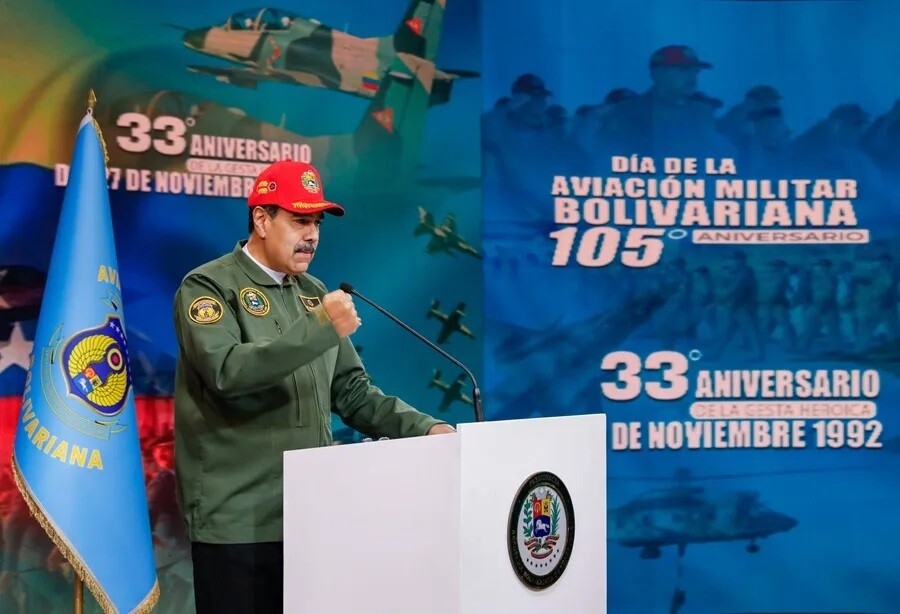
Venezuelan President Nicolás Maduro expressed confidence in victory should his country declare itself a 'republic in arms', amidst escalating tensions with the United States. On Monday, the U.S. State Department designated the so-called 'Cartel of the Suns' as a foreign terrorist organization, claiming that Maduro leads it alongside high-ranking Venezuelan military and government officials, though Caracas has dismissed this as a 'fabrication'. This tense situation has been compounded by a crisis in Venezuela's air connectivity since last Saturday, following the cancellation of international flights. The U.S. urged airlines to 'exercise extreme caution' when flying over Venezuelan territory and the southern Caribbean, citing a 'potentially dangerous situation'. In response, Caracas revoked the operating licenses for Iberia, TAP, Turkish Airlines, Avianca, Latam Colombia, and Gol.
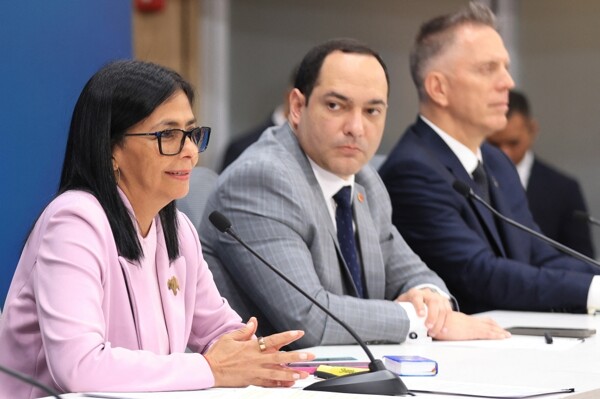
Vice President Delcy Rodriguez accused Washington of pressuring other nations to prevent their airlines from flying to the South American nation. During the nineteenth session of the Russia-Venezuela High-Level Intergovernmental Commission, held virtually, Rodriguez accused the Trump administration of seeking to 'isolate' the Latin American country. Meanwhile, Maduro asserted that his country has demonstrated in recent months 'an immense capacity for coordination, command, control, communication, and above all, popular-military-police unity' to defend 'peace and stability'. He expressed confidence in the 'fabulous force of resistance' that, he said, has awakened among the people despite what he called 'immoral pressures' from the U.S.
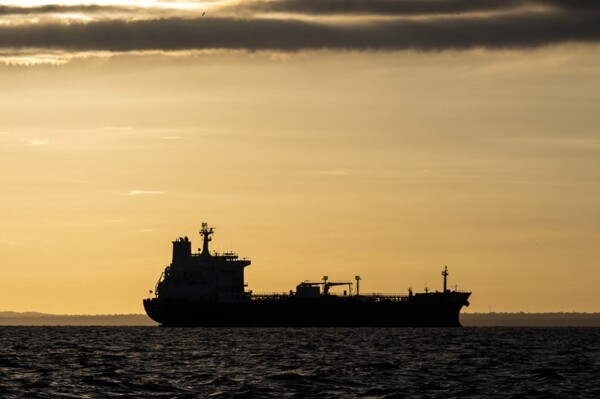
Under the pretext of combating drug trafficking and pursuing what it calls narcoterrorists, the U.S. maintains a military deployment in the Caribbean, recently reinforced by the arrival of its largest aircraft carrier, the USS Gerald R. Maduro, viewing this military buildup as a 'threat' to his power, has ordered the air force to remain 'alert and ready'.