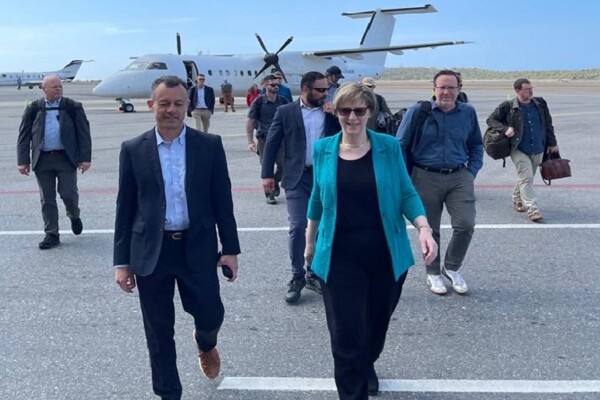
Venezuela’s interim president, Delcy Rodríguez, announced on Friday, January 30, the closure of the country’s most feared detention center, El Helicoide, while also announcing that she will promote a general amnesty for the hundreds of political prisoners who still remain in the jails of the South American country. According to the interim leader—who assumed her duties after Nicolás Maduro’s capture by the U.S. military—this decision was agreed upon with the deposed president and will be implemented through a law expected to be approved next week by the National Assembly, with the aim of “promoting coexistence” in Venezuela. Human rights defenders welcomed this announcement but said they would be monitoring the process of releasing political prisoners to ensure it does not include the release of common criminals. The announcement comes amid a wave of releases that began after the capture of Nicolás Maduro and Cilia Flores in the early hours of January 3, 2026, a move that has marked a turning point in Venezuelan politics. Furthermore, on January 8, the Delcy Rodríguez regime announced a process of releasing a “significant number” of political prisoners, although relatives of the detainees and human rights organizations have indicated that the releases are happening slowly and with restrictions. These efforts to secure their release are considered the result of intense international mediation, involving figures such as former Spanish Prime Minister José Luis Rodríguez Zapatero, Brazilian President Luiz Inácio Lula da Silva, and the Kingdom of Qatar, among others. In response to the measure, Alfredo Romero, president of the NGO Foro Penal, stated the following on his Twitter account: “A general amnesty is welcome as long as its elements and conditions include all of civil society, without discrimination, do not become a cloak of impunity, and contribute to dismantling the repressive apparatus of political persecution.” The United States Announces the Full Release of its Citizens Imprisoned in Venezuela. “We are pleased to confirm the release, by the interim authorities, of all known US citizens who were being held in Venezuela,” the diplomatic mission said. Laura Dogu, appointed by President Donald Trump as the new head of his diplomatic mission in Venezuela, arrived in Caracas on Saturday afternoon, January 31, as part of a process of gradually resuming bilateral relations between Washington and Caracas. Dogu’s arrival comes in the context of a telephone conversation between Trump and Delcy Rodríguez, which according to various sources lasted around 30 minutes and took place before the announcement of the General Amnesty Law for political prisoners and the decision to close the El Helicoide detention center in Caracas. Dogu’s appointment was previously confirmed by diplomatic sources and is listed in official State Department records. Following that statement, Rodríguez announced an amnesty and the closure of the El Helicoide torture center, located in Caracas. In announcing the general amnesty during an event at the Supreme Court, the interim president remembered her father, Jorge Rodríguez, who died in 1976 while in the custody of the secret police of the time. The father of the Rodríguez’s—a member of the Revolutionary Organization—was responsible that same year for the kidnapping of William Niehous, the local president of the Owens-Illinois company, whom he considered an “enemy of Venezuela.” “My father was imprisoned and died as a result of torture.” The Chavista leader asserted that the measure was also agreed upon with Maduro himself. “I ask everyone that no one resort to violence or revenge, so that we may all live with respect,” said Rodríguez. The administration of US President Donald Trump confirmed that “all” Americans who were detained in Venezuela have been released. The regime claims to have released more than 800 people since before December, and has asked the United Nations High Commissioner for Human Rights to verify that list. For its part, the Foro Penal organization has confirmed the release of at least 302 people following the process announced after the capture of Maduro. The measure, according to Venezuela’s interim leader, will be processed by the National Assembly and comes amid criticism for the slowness and discrepancies in the figures for prisoner releases. The amnesty announced by Rodríguez will also have broad application, effectively erasing the charges for which the detainees were originally imprisoned. However, Delcy Rodríguez clarified that those detained for homicide, drug trafficking, and other common crimes will be excluded from the amnesty. “We need more justice, with greater legal protection,” Rodríguez stated. For its part, the Committee of Mothers for the Defense of Truth—one of the non-governmental organizations that advocates for the rights of political prisoners—launched a signature-gathering campaign this week to promote an amnesty law for those imprisoned for political reasons. “I believe in the Constitution, in national sovereignty, and in justice for the Venezuelan people.” Dogu’s arrival occurred during a telephone conversation between Trump and Delcy Rodríguez, which, according to various sources, lasted around 30 minutes. So much so that there is a marked disparity in the figures: while the Chavista regime claims that more than 600 people have been released for political reasons, human rights organizations put the number of releases at 302. In contrast, the Helicoide – a building originally designed to serve as a shopping center – will be converted into a recreational and sports facility. The diplomat has served as U.S. ambassador to Honduras and Nicaragua and has experience in the region and in international security matters.