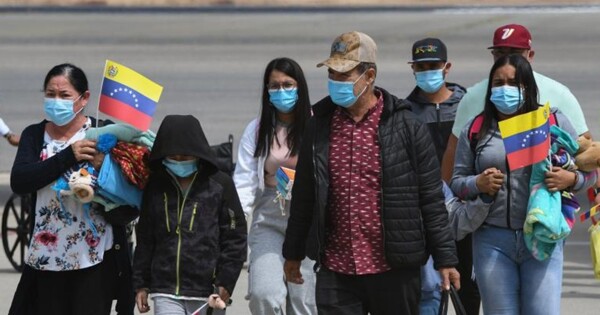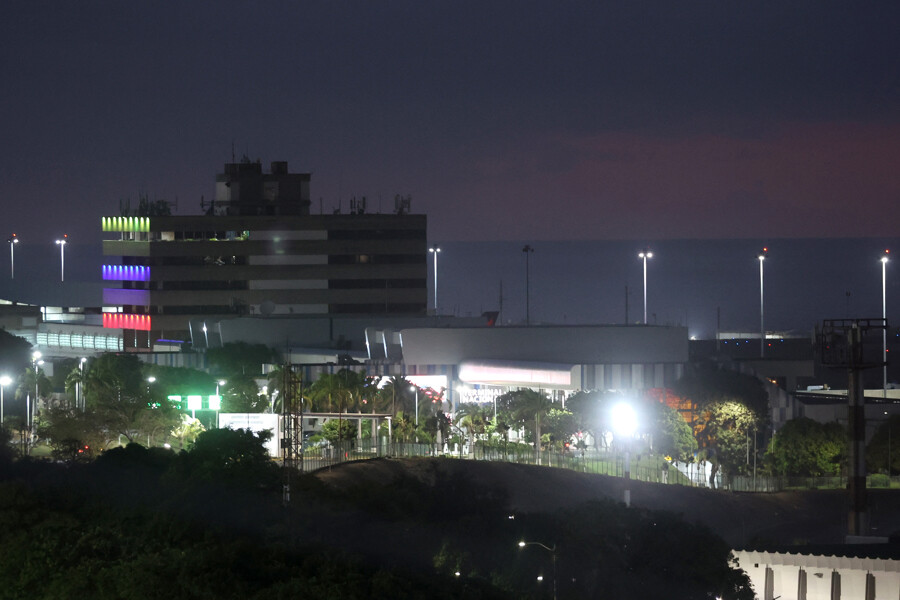
Several European and American airlines canceled their flights to Venezuela on Saturday after the U.S. Federal Aviation Administration (FAA) issued an international notice the day before urging to "exercise extreme caution" when flying over the South American country and the southern Caribbean Sea.
Spanish airline Iberia was the first to make the decision to cancel its flights to Venezuela—the first of which was scheduled for next Monday—and to inform that it will be evaluating the situation to decide when to resume its operations. Sources from the company told EFE that Iberia made that decision in line with what other airlines are doing regarding what is happening in Venezuela. The number of Iberia's commercial flights to Venezuela is five weekly.
Portuguese airline TAP canceled a flight scheduled for today and another for next Tuesday to Venezuela. A TAP source specified in response to EFE that they have adopted this measure to guarantee the safety of passengers and crew, "in accordance with international recommendations".
In turn, the Colombian airline Avianca canceled its flights on Saturday, while Wingo stated that its operations in the neighboring country are proceeding as normal. "We canceled today's flights due to operational adjustments and we are evaluating the situation like all airlines," a source from Avianca, which has two daily flights from Bogotá to Caracas, told EFE.
Brazilian Gol announced that it had canceled its flights to Caracas scheduled for this weekend. Gol had a flight scheduled for this Saturday from Guarulhos International Airport in the metropolitan area of São Paulo to the Venezuelan capital and another on Sunday, but both were canceled, according to sources from the company who spoke to EFE. The airline informed passengers with tickets for these flights that they can "reschedule their trips, request a credit, or ask for a direct refund".
This situation is taking place amid the military deployment ordered by the government of U.S. President Donald Trump in the waters of the Caribbean near Venezuela to fight drug trafficking. The U.S. campaign began in September and, to date, has consisted of bombing civilian boats allegedly linked to drug trafficking. These attacks have spread to the Pacific waters and have left more than 80 dead so far.
However, on Saturday, the Venezuelan government revealed the letters it has received from the presidents of Russia, China, Cuba, Nicaragua, and Belarus, all allies of chavism, who ratified their support for Nicolás Maduro, on the eve of his birthday and at a time when the chavista leader denounces the U.S. naval deployment in the Caribbean Sea as a "threat".
Venezuelan Defense Minister Vladimir Padrino López said that "no naval deployment" will take away Venezuela's independence after mentioning the military exercises of the United States in Trinidad and Tobago, an island that is about 11 kilometers from the nearest coast of the South American country. In a Saturday broadcast on the state channel Venezolana de Televisión (VTV), Padrino stated that "no threat, no naval deployment, no matter how powerful or intimidating it may try to be" will take away Venezuela's right to follow its path of "freedom and independence".