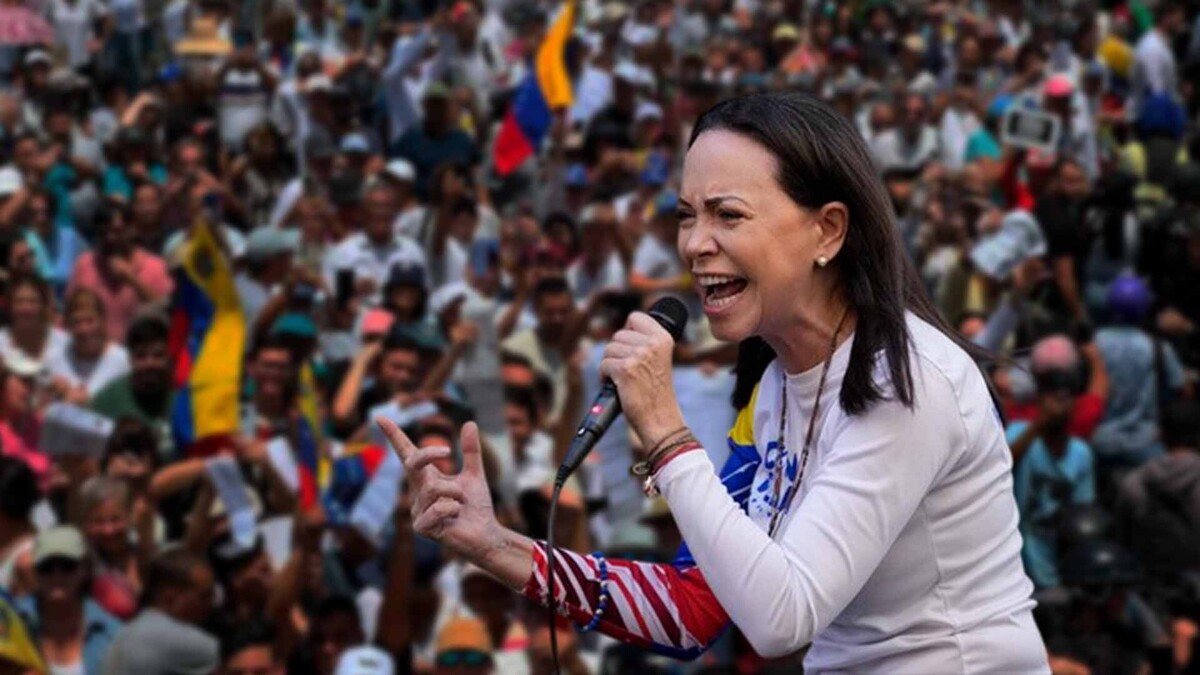
The “freedom” that María Corina Machado promises for Venezuela comes with an ambitious plan focused on the privatization of oil, economic deregulation, fiscal deficit reduction, and the elimination of taxes for the richest. Meanwhile, financial entities like Union Bank of Switzerland (UBS) back this vision with reports such as “Venezuela: Visualizing the day after tomorrow,” which states that the South American country has the “world's largest proven reserves of crude oil.” Although it is heavy crude that requires specialized refineries, its low extraction cost—between $20 and $30 per barrel—and its geographical proximity to major consumer markets, like the United States, make it a high-value strategic asset.
The report projects that Venezuela could return to producing three million barrels per day in 15 years, which would benefit the energy security of the United States and the profitability of its oil companies. It also considers the sale of assets in the petrochemical, steel, bauxite, and telecommunications industries. Economist Sara Levy, linked to libertarian networks like Atlas Network and CEDICE-Venezuela, estimates that oil production could reach 4.7 million barrels per day in fifteen years, generating a $420 billion market. According to María Corina Machado, a post-Maduro Venezuela would be “pro-business,” moving from an “economy controlled by the state to one driven by the private sector, with public-private partnerships, privatizations, and open competition as the norm.”
This proposal also aims to turn the South American country into a “strategic hub” for multinationals in sectors such as data centers, tourism, the real estate market, and the sale of state-owned companies. As part of this roadmap, the opposition team is negotiating loans of up to $70 billion with the International Monetary Fund, the World Bank, and the Inter-American Development Bank, which they claim are intended for infrastructure and public services.
Oil Reserves: The True Objective of the U.S.
Although Venezuela is not for sale, the opposition leader already has the catalog ready. On January 6, 2025, Machado and four members of her team presented to Senator Mike Waltz—then nominated by Donald Trump as Secretary of National Security—the thesis that Nicolás Maduro led the Tren de Aragua. This narrative was sustained and reiterated by Machado and her team in successive meetings until the U.S. government declared the gang a “terrorist organization,” according to a Reuters report based on testimonies from 50 sources.
The designation not only escalated the diplomatic conflict but also served as a basis for the mass deportation of Venezuelan migrants under the Enemy Foreigners Act, many of whom ended up in prisons like CECOT in El Salvador. Meanwhile, María Corina Machado promoted her economic plan, which she called a “billion-dollar opportunity,” with an emphasis on the privatization of oil, fiscal deregulation, and full openness to foreign capital. In forums like the Council of the Americas, CeraWeek, and the American Business Forum, she presented Venezuela as a “sexy” destination for business, promising institutional stability, legal guarantees, and energy profitability.
“I have had forums with many business sectors around the world, where Venezuela has become ‘sexy’; everyone wants to know how we are going to open the economy, generate the rule of law, where the guarantees for investment will be, the incentives,” she expressed recently. Her statements generated strong controversy, as they clearly revealed that her project responds to the interests of Washington: “There is no country that has the opportunity to take off and generate energy security for the United States, and other countries, like Venezuela,” she said.
Financial Giants and Libertarian Networks Behind the Project
The heart of the plan revolves around the privatization of key sectors such as oil and gas through a state agency. Her project, presented at international forums and backed by financial networks and libertarian think tanks, seeks to transform the country into a strategic enclave for energy, banking, and technology corporations. Added to this are minerals such as gold, iron, and bauxite, as well as fertile agricultural lands.
The actions of the far right confirm the repeated denunciations of the Nicolás Maduro government: the true objective of the far right and Washington is the appropriation of Venezuela's natural resources, with María Corina Machado as the intermediary. Under the discourse of “freedom” and “national reconstruction,” a Venezuela subordinate to the strategic interests of the United States is projected, where oil, gold, and fertile land would once again become bargaining chips.