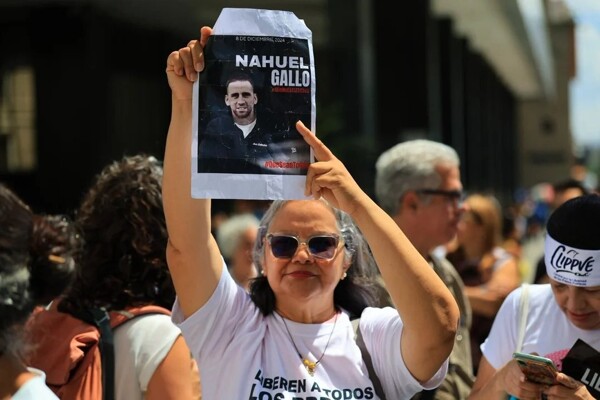
The National Assembly (AN, Parliament) of Venezuela postponed this Thursday to next week the second and final debate necessary to approve the amnesty bill for political prisoners since 1999, while the opposition took to the streets of the country to demand the release of these detainees. The Parliament -controlled by chavism- approved up to the sixth article of the so-called Law of Amnesty for Democratic Coexistence, due to disagreements on the seventh point that requires the prosecuted and convicted to appear before Justice. Article seven of this project states that amnesty is for any person who is or may be 'prosecuted or convicted for their alleged or proven participation in crimes or offenses', as long as 'they are at law or come to law after the entry into force' of the regulation. Opposition deputy Luis Florido, from the Freedom fraction, indicated that the article had to be modified because, in his opinion, the request to appear before the court already implies a guilty verdict for people who are judicialized. Chavism, on the other hand, argued that the Constitution establishes that persons must be present in a criminal process. Finally, the debate was postponed, at the request of chavism and the opposition, for a next session that is estimated to be next Thursday, after the Carnival holiday. Among what was approved during the session, the future law grants 'a general and full amnesty for the crimes or offenses committed and occurred within the framework of the facts and the temporal scope' established in the text, in order to 'promote social peace and democratic coexistence'. The protest returns On the occasion of National Youth Day, the Venezuelan Student Movement marched this Thursday in several cities of the country to demand the release of all political prisoners, which represented one of the opposition mobilizations with the greatest attendance for a little over a year. Hundreds of people gathered at the Central University of Venezuela (UCV), the country's main university, where student leaders and citizens mobilized inside and outside the campus in Caracas. 'Not one, not two, let them all be,' chanted the protesters, referring to the process of releases of political prisoners that began on January 8, through which the NGO Foro Penal has verified 431 releases until February 10, while estimating that there are still more than 600 imprisoned. Miguel Ángel Suárez, president of the Federation of University Centers of the UCV, assured that they will continue to pressure 'until all civil and political rights are restored', while asking that 'persecution cease' and achieve 'guarantees' that lead the country to a 'democratic transition'. In Maracaibo, capital of the state of Zulia (west), students from the University of Zulia (LUZ) also marched and demanded to be included in the debate on amnesty. Yeissel Pérez, president of the FCU of LUZ, questioned that youth leadership was not summoned for the public consultation of the bill, in which academics, NGOs and relatives of political prisoners participated. Relatives in protest Relatives of political prisoners detained in the command of the Bolivarian National Police (PNB), known as Zone 7 in east Caracas, held a new protest at the end of the day outside that headquarters to demand that their relatives be released, as well as to reject that the debate in Parliament had been deferred. Yessy Orozco, daughter of the former deputy Fernando Orozco detained in that jail, told EFE that they will chain themselves outside the PNB until they release all political prisoners from that facility. 'We are going to remain chained here, no one enters, no one leaves, unless they release our political prisoners, until the last of our political prisoners leaves this penitentiary center,' she added. Orozco recalled that last Friday the president of the Parliament, the chavist Jorge Rodríguez, said that the bill would be approved this week after which all political prisoners would be released. On this, Petra Vera, relative of another detainee in Zone 7, demanded Rodríguez to 'fulfill his promise'. 'We are protesting because of the mockery to which we have all been subjected, the relatives of the political prisoners of this penitentiary center, we consider it a mockery,' she declared to EFE.